
Jim Crow and Racial Partitioning of Public Spaces
Explicit racial zoning failed in Falls Church due to a U.S. Supreme Court decision on a property rights case (Buchanan v. Warley, described in Frederick ("Freddie") Foote, Jr. and Tinner Hill) that arose in Kentucky. But its geographic battle points to a more complicated narrative about the intertwining of eugenics and anti-Black spatial laws in Virginia. When viewed together, these dual histories illuminate the engineering of a legal landscape designed to marginalize African Americans. The constitutional disenfranchisement of 1902 separated Black men from their rights as citizens, disenfranchising them and suppressing Black political power for generations. Over the following decades, meanwhile, another slate of Jim Crow acts racially partitioned public spaces, including streetcars, railroads, and residential areas, for all Black Americans.
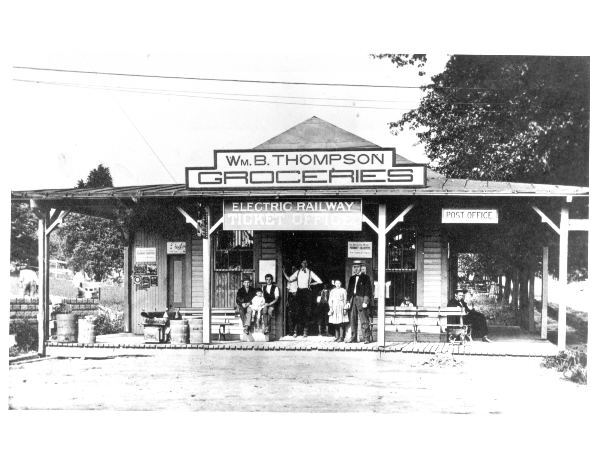
East Falls Church Trolley Station, 1910. Courtesy of Mary Riley Styles Public Library, Falls Church History Collection, Falls Church, VA.
Transit was one of many public sites subjected to such strictures. In 1904, an article in the Fairfax Herald, captured the spatial battle over seating on the trolley: “The trolley had brought a large number of lawless characters to the county (to include) some of the Negroes employed on the new electric railroad…When attempted…we would advise our people to pump lead into the rowdies until they become fit subjects for a junk shop.” This rhetoric not only disparaged Black workers but also misrepresented them as criminals. In another account presented in the Herald, readers learned about an African American woman, Barbara Pope, who lived in D.C. but commuted to Falls Church to work. According to the author, Pope refused to sit at the back of the trolley. She would not abide by the second-class citizenship imposed by Jim Crow geography, and as a consequence, was removed from the car. Unbowed, Pope sued the trolley operator and won: She was “awarded one cent in damages.” These examples highlight how the architecture of Jim Crow functioned as a legal mechanism to humiliate, confine, exclude and oppress Black residents in Fairfax and surrounding jurisdictions. These political and social constraints laid the groundwork for the racial integrity campaign of the 1920s.
Virginia’s enactment in the 1920s of the notorious, eugenics-based Racial Integrity and Sterilization Acts helped cement the state’s edifice of anti-Black repression, built on separating Black rights and Black bodies from full participation in civic life (as further outlined in Walter Plecker's Legacy). The goal was to enshrine White rule.
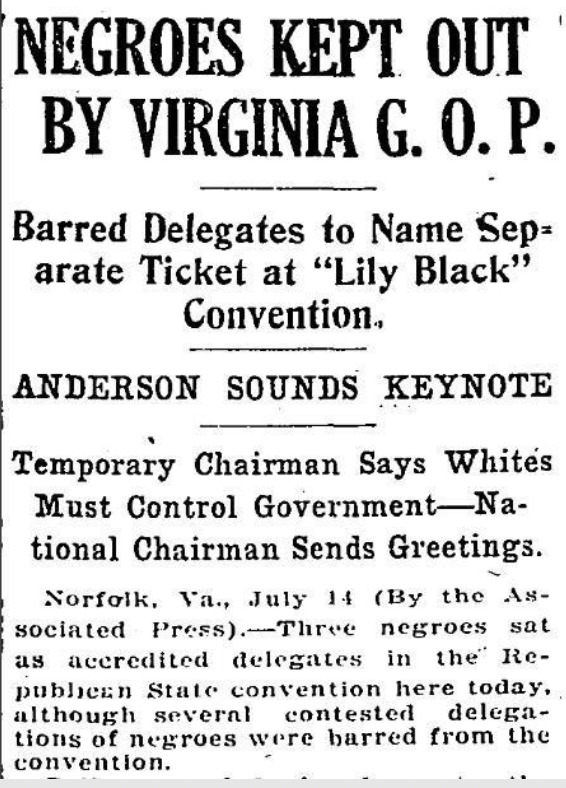
Washington Post, July 15, 1921
These were the influences shaping the attitudes of Fairfax’s White residents as they made decisions about how a growing county would allocate its resources. Land use, building codes, real-estate investments, neighborhood ordinances, recreation funding, lending and allocations for schooling all rested on these racially discriminatory rules and beliefs. Even ideas about their very homes—the idea of a single-family suburban residence as the preferred twentieth-century living space—grew out of racial stereotypes and discriminatory policies. As real estate markets grew after the Civil War, developers had reason to privilege multi-housing units, including apartments, that maximized land values. Toward the end of the century, however, this profit motive bumped up against a cultural unease with the era’s myriad social and political changes. For some members of the White middle class, already unsettled by industrialization, mass immigration, urbanization, and a new mobility among Black people, housing density and the proliferation of apartment blocks seemed to threaten public health, social identity, and civic cohesion.
Apartment houses soon came to be viewed as “a grave threat to American society,” according to Robert Fogelson, a historian of suburbia. “With their common hallways and stairways, they spread infectious diseases,” went the narrative, “… spew[ing] smoke and soot” and noise. A judge in North Dakota expressed a general classist disdain when he declared them “a major cause of ‘the great increase’ in crime and delinquency,” their occupants “less moral” than residents of single-family dwellings. The worry of many across the country, writes Fogelson, was that building multifamily housing would attract the “wrong sort of people” and that the only “true” homes were single-family-occupancy homes; the corollary was that the presence of apartment buildings would render neighboring property less valuable for “home” (single-family) construction. The rhetoric employed invokes a colorblind, seemingly race-neutral argument. The nonracial characteristics such as “wrong sort of people” or “less moral” individuals empowered homeowners to exclude multiracial housing projects and Black homeowners based on assumed cultural facts and the desire of White residents to protect their investment.
What that bias meant in practice, however, was a dearth of affordable housing. For the first half of the twentieth century Arlington and Fairfax counties, writes historian Krystyn Moon, “working-class families trying to support themselves” often lived in “[s]elf-built homes, [with] large gardens, farm animals, no services (such as water and sewer lines), and lodgers.” But such flexible arrangements dwindled as rural land grew scarcer and county regulation expanded. Anti-apartment sentiment among Fairfax officials stymied efforts to build apartments or even modest rowhouses to replace them, meanwhile. Not surprisingly, investment dollars increasingly followed government favor away from denser models and into single-family construction.