The Hopewell Lodge No. 1700 of the Grand United Order of Odd Fellows
Item
-
Subject of Research
-
The Hopewell Lodge No. 1700 of the Grand United Order of Odd Fellows
-
Story
-
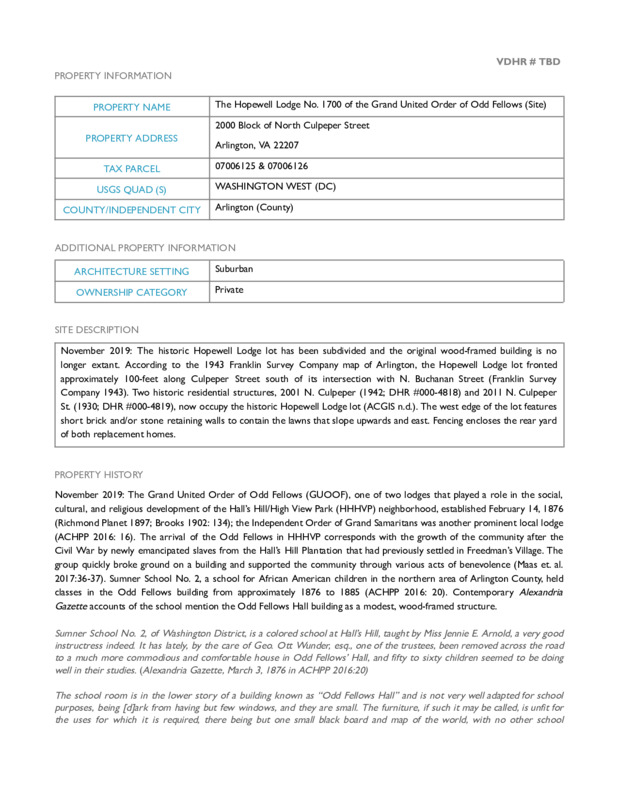
The Grand United Order of Odd Fellows (GUOOF), one of two lodges that played a role in the social, cultural, and religious development of the Hall’s Hill/High View Park (HHHVP) neighborhood, established February 14, 1876 (Richmond Planet 1897; Brooks 1902: 134); the Independent Order of Grand Samaritans was another prominent local lodge (ACHPP 2016: 16). The arrival of the Odd Fellows in HHHVP corresponds with the growth of the community after the Civil War by newly emancipated slaves from the Hall’s Hill Plantation that had previously settled in Freedman’s Village. The group quickly broke ground on a building and supported the community through various acts of benevolence (Maas et. al. 2017:36-37). Sumner School No. 2, a school for African American children in the northern area of Arlington County, held classes in the Odd Fellows building from approximately 1876 to 1885 (ACHPP 2016: 20). Contemporary Alexandria Gazette accounts of the school mention the Odd Fellows Hall building as a modest, wood-framed structure.
Arlington County land records from August 28, 1888 list Moses Jackson, George H. Hyson, Shirley Snowden, Joseph Bolden, and Horace Shelton as purchasers of one acre of land for $80 from the Bazil Hall Plantation on behalf of the Grand United Order of Odd Fellows, Hopewell Lodge No. 1700 (ACHPP 2016:15; Jones 2018:16). The 1943 Franklin Survey Company map of Arlington County identifies the Hopewell Lodge as located between the John M. Langston School and the Mt. Salvation Baptist Church at ~2020 N. Culpepper Street.
The GUOOF came to be a predominately African American group in the United States although the fraternal order was founded in England in 1798 and a few unofficial chapters had begun in place in the early 1840s. In March 1843, the African-American New York Philomathean Institute and Philadelphia Library Company and Debating Society became the first two official GUOOF lodges; each had denied acceptance by unofficial local chapters due to racial prejudice. Peter Ogden, a West Indian steward of the S.S. Patrick Henry, a British vessel, facilitated the establishment of the two lodges which set precedence for the chapters in Arlington, Va. By 1900, the GUOOF in America was the second largest African American fraternal organization with over 200,000 members and over 2,000 lodges. Its membership consisted mainly of lawyers, doctors, military officers, ministers, and other professionals (GUOOFA n.d.). Despite their Mason-like power structure, the Odd Fellows utilized Biblical content in their rituals for lodge establishment. “Many historians note the Odd Fellows as one of the most significant black mutual aid societies even at its beginning stages in the 1840’s, and the hybrid of non-denominational Christian content and a Mason-modeled organizational structure may have been why” (Barga n.d.).
-
People
-
Miss Jennie E. Arnold
Geo. Ott Wunder, esq.
Moses Jackson
George H. Hyson
Shirley Snowden
Joseph Bolden
Horace Shelton
Peter Ogden
-
Place
-
Halls Hill/Highview Park
2000 Block of North Culpeper Street
Arlington, VA 22207