Black Land/Property Ownership
This section of Black Land Matters aims to capture specific individuals and instances of Black land/property ownership, while documenting the legacy of that property ownership passing to their progeny.
- Subject of Research
- Levi Jones; October 7, 1844
- Story
-
Levi Jones, a free black man, purchases 14 acres from Elizabeth Baggot in what is now Green Valley to be near his enslaved wife Sarah Ann Gardener. Plantation owner, Alexander Frazier, enslaves Sarah and their growing family. After the Civil War, the family helps develop Nauck/Green Valley as an African American community.
“Whenever, the Union soldiers would come around and want anything I had, and had no money for it, I would give it to them. I gave them milk. That is about all I had to give them… I knew what side I was on, I had no vote before the war… " - Levi Jones, 1872 - People
-
Levi Jones
Sarah Ann Gardener
Elizabeth Baggot
Alexander Frazier - Place
- Green Valley
- Source
- A-Guide-to-the-African-American-Heritage-of-Arlington-County-Virginia.pdf; page 23.
- Item sets
- Black Mobility Archive: Arlington, VA
- Media
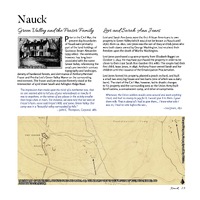 Pg23-LeviJones Map.jpg
- Subject of Research
- Petition of William Syphax; Confederate Newspaper; Alexandria Gazette; May 5, 1866
- Story
- "In the Senate, yesterday, Mr. Van Winkle presented six different remonstrances from citizens of Alexandria county against the passage of the bill retroceding that county to the District of Columbia. Referred to the Committee for the District of Columbia. Mr. Harris presented the petition of William Syphax, a former slave on the Arlington estate, asking Congress to confirm him in the possession of fifteen acres of land left to his mother by the late G. W. P. Custis. Referred to the Committee on Private Lands."
- People
- William Syphax (formerly enslaved); his enslaved mother, G.W.P. Custis
- Place
- Alexandria County; Arlington estate
- Source
- FOLDER: Confederate Newspaper; FOLDER: Slave; Alexandria Gazette; May 5, 1866; https://drive.google.com/drive/u/0/folders/1m5pbDFo_tkPr8AbfRYN4GxfOxK77rxri
- Item sets
- Black Mobility Archive: Arlington, VA

- Subject of Research
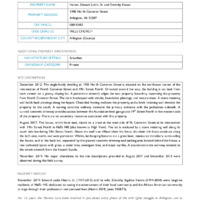
- The Home of Dorothy and Edward Leslie Hamm Sr.
- Story
-
Edward Leslie Hamm, Sr. (1917-2013) and his wife, Dorothy Bigelow Hamm (1919-2004) were longtime residents of Hall’s Hill, dedicated to seeing the advancement of their local community and the African American community at large through their professional and personal lives (Hamm 2019; Jones 2018:73).
For 15 years the Hamms have been involved in just about every phase of the civil rights struggle in Arlington, not to mention the fact that they as much as anyone are responsible for the neighborhood conservation program…Determined to change their neighborhood as well as the world, they joined everything, lent their time and effort and money to any project. The NAACP, Mount Salvation Church, the Arlington Council on Human Rights, Norther Virginia Fair Housing, Hurelco (a land development company that is color blind), the County Advisory Committee on Health and Welfare, the County Neighborhood Conservation Committee, the League of Women Voters, the John M. Langston Citizens Association (she is outgoing president), and many more. (Buchard 1969)
Edward Hamm was an architect who apprenticed with architect Romulus Cornelius Archer, Jr., an African-American architect who opened a private practice in Washington, D.C. in 1921 and became the second licensed African American architect in the city in1926 (ACHPP 2016: 30; Maas et al. 2017: 69). Romulus Cornelius Archer, Jr. studied architecture through the International Correspondence School in Scranton, PA and finished his architectural studies at Columbia in 1913.
Hamm designed and constructed the residence located at 1900 N. Cameron Street “brick by brick and board by board, and Mrs. Hamm worked, first as a seamstress and then at Government jobs leading up to an administrative secretary in the Army Surgeon General’s office, to help put the materials, a pound of nails and a bag of mortar at a time. The building took five years” (Buchard 1969). Hamm graduated from the Hampton Institute (now Hampton University) in 1940 with a degree in Building Construction. From 1946 to 1960, Hamm worked as a Draftsman, Job Captain, Chief Draftsman, and Office Manager for R.C. Archer & Associates and Mills, Petticord & Mills, two private Washington, D.C. based architecture firms, before working with the U.S. General Services Administration (GSA). While with the GSA he was responsible for varying roles as an architect to include review, coordination, and construction management and design. Hamm was the Project Review Architect for the construction of the John F. Kennedy Cultural Center for the Performing Arts and Project Coordinator for the Federal Triangle Project. He also served as Acting Chief of the Architectural Section and the Office of Construction Management Coordinator on GSA Demonstration Projects which were designed to demonstrate environmental enhancement and energy conservation. Upon retirement in 1977, Hamm was Chief Architect and Energy Conservation Coordinator for the Professional Service Division (Hamm 2019; HDFH 2013; Maas et. al. 2017: 71).
In his local community, Hamm was the project architect for the renovation and expansion of the 1904 Calloway United Methodist Church (Calloway Church) at 5000 Lee Highway in 1979. The $235,000 renovation almost doubled the original square footage of the church and featured an open bell tower, an expanded choir loft, a front entrance vestibule, and educational classrooms (ACHPP 2016: 18). Hamm and his family were congregant members of Calloway Church. As an active community member, Hamm served the Arlington Neighborhood Conservation Committee, Board of Directors for the Arlington Interchurch Committee on Housing for Low Income Families, the Arlington Council on Human Relations; the Northern Virginia Fair Housing Association; the County Advisory Board on Health and Welfare; and the National Association for the Advancement of Colored People for over 50 years (HDFH 2013; Maas et. al. 2017: 71; Bestebreurtje 2017:352-353, 361-365; Hamm 2019; Jones 2018:138).
Dorothy Hamm was also a prolific and active community member. She, along with members of the black and white communities, worked to integrate Arlington County schools (Maas et. al. 2017: 54). In 1956, she and her eldest son, Edward Leslie Hamm, Jr. joined a group of families in a civil suit to integrate the all-white Stratford Junior High (Stratford High) (Jones 2018:105); the suit was Clarissa S. Thompson et al. v. the County School Board of Arlington, 159 F. Supp. 567 (E.D. Va. 1957). Though the 1956 civil suit was unsuccessful, in 1958, by order of the U.S. District Court, Stratford Junior High became the first white public school in Virginia to desegregate. Desegregation was an arduous process and Dorothy Hamm was a participant in challenging the Pupil Placement Act, which was designed to delay school integration while giving the appearance of compliance (Virginia Changemakers n.d.). The Hamms were collectively involved in challenging Virginia’s poll tax in 1963. Later the same year Dorothy Hamm was arrested for her involvement in the public protest to desegregate Arlington theatres. The arrest did not deter her efforts as she remained politically and civically active serving as a delegate to Arlington County and state conventions in 1964, was appointed assistant registrar and also a chief election officer in the Woodlawn precinct in Arlington. Ms. Hamm also worked to establish a local chapter of the Congress on Racial Equality organized in Arlington and participated in the 1968 "Poor People's March on Washington" (Virginia Changemakers n.d.; Hamm 2019). She became the first recipient of the Arlington County Martin Luther King Jr. Award for Outstanding Volunteer Service in 1982 and the Virginia House of Delegates honored her lifelong contributions in a joint resolution in 2002. Dorothy Hamm’s most recent, post mortem accolades include recognition by the Virginia Women’s Monument Commission “Voices from the Garden” project and honor for the historic role she played in integrating Stratford Junior High School. The newly renovated Stratford Junior High, a National Register of Historic Places (NRHP)-listed resource, Virginia Landmark and Arlington County Historic District, will reopen as the Dorothy Hamm Middle School beginning with the 2019-2020 school year (Jackson 2018). - People
- Edward Leslie Hamm, Sr. and Dorothy Bigelow Hamm
- Place
-
Hall's Hill Neighborhood
1900 North Cameron Street
Arlington, VA 22207
- Item sets
- Black Mobility Archive: Arlington, VA
- Subject of Research
- Moore’s Barber Shop (Current and Historic)
- Story
-
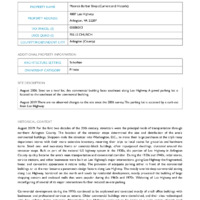
This building was built in 1940 by the Fairway Homes Company, according to Arlington County building permit #102878C (Arlington County 2019). The 1955 Arlington County directory lists LH Morgan’s Barber Shop and Ruby’s Beauty Shop, with Moore’s Barber Shop and Apts. listed in 1959, 1961, 1967, and 1972 directories (Hill Publishing Company 1955-1976).
During the Spring of 2017, students in the Urban Design Studio at Virginia Tech’s Master’s in Urban and Regional Planning Program (Alexandria campus) partnered with Arlington County’s Historic Preservation Program (HPP) to document and map “Legacy Businesses,” defined as those businesses in operation for more than 10 years. The study also gave special attention to businesses over 25 years old in the Green Valley neighborhood and along Lee Highway in Arlington, both of which are undergoing redevelopment and/or community visioning processes. Through oral interviews and archival research, the study produced short histories of several businesses in relation to the overall Arlington community. The goal of the project was to highlight the stories and voices associated with long-time places that may not be typically viewed as “historic” resources, but that nonetheless comprise an essential part of community character and vitality (Virginia Tech UAP 2017).
From the Legacy Business website at: https://www.legacybusinessarlington.com/moores-barber
Mr. James Moore, Sr., established Moore’s Barber Shop in Hall’s Hill in 1960. In 2002, the elder Mr. Moore retired and turned over the business to his son, James Moore, Jr. He had been working in the shop since he was seven years old, sweeping the floors and doing other odd tasks, and eventually joining as a full-‐time barber in 1991. The barber shop has long been known as place for not only a great haircut, but also lively conversation and a friendly atmosphere. Its walls are papered with photos of clients and other memorabilia marking historic moments in the D.C. region and country.
Mr. Jim Moore, Sr., started the barber shop in 1960, originally with a partner and at a different location a few blocks down on Lee Highway (where the KFC is now). The younger Mr. Moore started working in the shop when he was 7 years old, sweeping the floors and doing other odds and ends for a dollar per day. This continued through his youth. In 1991 he started working there full time as a barber, which allowed Mr. Moore Sr. to step back a bit from his work until he fully retired in 2002. Mr. Moore explained that many of the small independent barber shops don’t exist anymore due to competition with low-‐cost chains. Historically, the barber shop business was one of the few businesses black men could open and use to support their families. The barber shop is about personal service and relationships, and Moore’s has been able to maintain those over the years. They have generations of clients now who have been coming there for decades, and many from far away. Many young people who come are not as engaged in conversations, and Mr. Moore has had to use social media more to promote their shop in addition to word of mouth. - People
-
James Moore Sr.
James Moore Jr. - Place
-
4807 Lee Highway
Arlington, VA 22207
- Item sets
- Black Mobility Archive: Arlington, VA
- Subject of Research
-
Rick’s Tattoo Studio (Current)
Judge Thomas R. Monroe Law Office (Historic) - Story
-
PROPERTY HISTORY
November 2019: This was an African American-owned building built and managed by area resident Vance Green who also operated multiple businesses from the property, including a barber and beauty shop. Green leased other office space to a dentist and the law office of attorney Thomas Monroe (Green 2019). Thomas R. Monroe (1924-2005) opened his law office on Lee Highway in 1955, the same year he became president of the Arlington County chapter of the National Association for the Advancement of Colored People; he was president through 1956. Arlington County Directories from 1955 to 1964 confirm Monroe’s law practice located at 4818 Lee Highway (Hill’s various dates). From 1955 to 1959, his law firm was named Hankins, Myer & Monroe; it was listed as Myers & Monroe in 1961 and 1964.
In 1968, Monroe joined the law firm Bean, Kinney & Korman as the first African American partner in a non-minority law firm in Virginia (BKK n.d.). In four short years, he was appointed to the bench where he served as the first African-American Circuit Judge in Arlington County and the first to serve on all three Arlington courts. Judge Monroe retired from Arlington County judiciary in 1993 leaving a legacy of “compassion as well as competence” according to then-fellow Chief Circuit Judge William L. Winston (Winston in Sullivan 2005). He was a substitute judge in Juvenile and Domestic Relations Court in 1972, a General District Court judge in 1976 and the state's second black Circuit Court judge in 1982 (Sullivan 2005).
Judge Monroe was a graduate of Johnson C. Smith University in Charlotte, VA and served as an Army sergeant during World War II before studying law at Howard University. As a community member, Monroe was active during desegregation, presided over the Nauck Citizens Association, was board member of the Arlington County Action program active on the Human Relations Commission of the county’s Criminal Justice Advisory Committee.
SURVEYOR ASSESSMENT/RECOMMENDATION
November 2019: Although a commercial building, 4818 Lee Highway was not identified in the Arlington County Historic Resources Inventory (HRI) in 2011 (Arlington County 2011).
The commercial building at 4818 Lee Highway is eligible for listing in the National Register of Historic Places (NRHP) under Criterion A on the local level for its historical association with social and civil rights activism in Arlington County as well as the African American heritage in the Hall’s Hill/High View Park (HHHVP) neighborhood. Under Criterion B, the commercial building is eligible for its association with Judge Thomas R. Monroe, who was known for his social and civil rights activism in the predominately African American HHHVP community. Judge Monroe was significant for his legal achievements as a president of the Arlington chapter of the NAACP, as the first African American Circuit Judge in Arlington County and the first to serve on all three Arlington courts. It is eligible under Criterion C as embodying the characteristics of commercial architecture along Lee Highway including its two-story height, brick veneer, large display windows, and parapet roof. The building retains its integrity of location, design, setting and feeling. However, the alterations to the facade impact its integrity of materials and workmanship. Also, the law office of Judge Monroe no longer operates in the building which impacts its integrity of association. - People
- Thomas R. Monroe Esq. (1924-2005)
- Place
-
4818 Lee Highway
Arlington, VA 22207
- Item sets
- Black Mobility Archive: Arlington, VA
- Subject of Research
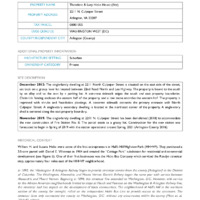
- Theodore & Lucy Hicks House
- Story
- William H. and Susana Hicks were some of the first entrepreneurs in Hall’s Hill/Highview Park (HHHVP). They purchased a 3.5-acre parcel with Daniel E. Wiseman in 1904 and created the “Cottage Park” subdivision for residential and commercial development. One of their first businesses was the Hicks Bus Company which serviced the Rosslyn streetcar stop, approximately four miles east of the HHHVP neighborhood. See Theme 2 for more information.
- People
-
Theodore Hicks
Lucy Hicks - Place
-
Halls Hill/Highview Park
2211 N. Culpeper Street
Arlington, VA 22207
- Item sets
- Black Mobility Archive: Arlington, VA