-
Subject of Research
-
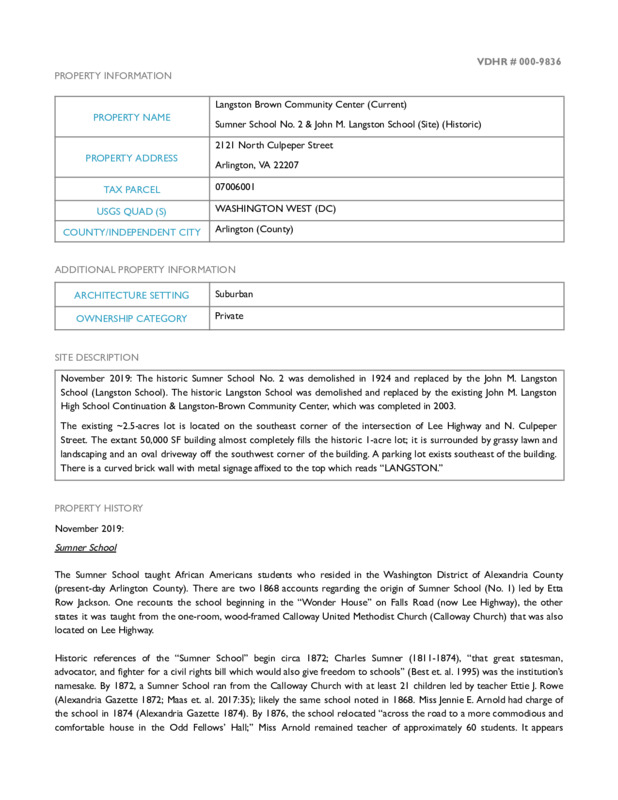
Langston Brown Community Center (Current)
Sumner School No. 2 & John M. Langston School (Site) (Historic)
-
Story
-
Sumner School
The Sumner School taught African Americans students who resided in the Washington District of Alexandria County (present-day Arlington County). There are two 1868 accounts regarding the origin of Sumner School (No. 1) led by Etta Row Jackson. One recounts the school beginning in the “Wonder House” on Falls Road (now Lee Highway), the other states it was taught from the one-room, wood-framed Calloway United Methodist Church (Calloway Church) that was also located on Lee Highway.
Historic references of the “Sumner School” begin circa 1872; Charles Sumner (1811-1874), “that great statesman, advocator, and fighter for a civil rights bill which would also give freedom to schools” (Best et. al. 1995) was the institution’s namesake. By 1872, a Sumner School ran from the Calloway Church with at least 21 children led by teacher Ettie J. Rowe (Alexandria Gazette 1872; Maas et. al. 2017:35); likely the same school noted in 1868. Miss Jennie E. Arnold had charge of the school in 1874 (Alexandria Gazette 1874). By 1876, the school relocated “across the road to a more commodious and comfortable house in the Odd Fellows’ Hall;” Miss Arnold remained teacher of approximately 60 students. It appears another school, the “Independent School” began in the Mt. Salvation Baptist Church soon after the Sumner School relocated to the Odd Fellows Hall in 1876 (Best et. al. 1995). It is hypothesized that the reference to a Sumner School No. 1 and No. 2 began around this time to differentiate between the two schools that likely administered to two different age groups. The following is a description of the Sumner School No. 2 conditions in 1879:
“The next school visited was Sumner, No. 2, taught by Mr. R. W. Whiting, colored. This is a colored school, mixed in sexes, and has upon its roll fifty pupils, twenty five of whom were present, they being the youngest on the roll, the largest ones being required this time of year to work…The school room is in the lower story of a building known as “Odd Fellows Hall” and is not very well adapted for school purposes, being [d]ark from having but few windows, and they are small. The furniture, if such it may be called, is unfit for the uses for which it is required, there being but one small black board and map of the world, with no other school appliances than a few rickety desks and benches unfit for school purposes.” (Alexandria Gazette, November 27, 1879 in ACHPP 2016:20)
Although there was no reference to a second school in the 1879 article, by 1885 the Washington School district decided to purchase a half-acre lot from Bazil Hill to construct Sumner School No. 2 at the current site (Vogel 1997:33; ACHPP 2016:20; Maas et. al. 2017:60). The Sumner School No. 2 included students from the earlier Sumner School and the Independent School. Arlington County land records list the school district’s purchase on August 10, 1885 for 75 dollars (ACHPP 2016:15). Mrs. Roberta Whiting was a newly elected teacher to the Sumner School No. 2 in 1903 (The Evening Star 1903). In 1924, following post-World War I expansion needs, the school was demolished to construct the John M. Langston School. L.C. Baltimore had been the Sumner School principal for 11 years when the replacement school was constructed in 1924 (ACHPP 2016:2; Maas et. al. 2017:60; Jones 2018: 16).
John M. Langston School
The John M. Langston School site is the former location of the Julius Rosenwald John M. Langston School. The school’s namesake, John Mercer Langston (1829-1897), was born a free African American man in Louisa County, Virginia. His father, Ralph Quarles, was the slave holder of his emancipated mother, Lucy Jane Langston. Both of Langston’s parents died in 1834 and William Gooch, a friend of Quarles, raised him and his older sibling in Ohio (Library of Virginia n.d.; Yee 2017; Dinnella-Borrego 2018). Langston studied at the Preparatory Department of Oberlin College, an academic institution considered radical at the time as the first American college to admit black and white students. Upon completion of his Oberlin studies, Langston was the fifth African American male graduate. Langston became a renowned abolitionist, politician, attorney, and educator. In 1864, Langston was elected president of the national Equal Rights League. In 1869, he became the first dean of the Howard University law school in Washington, D.C. after playing a key role in its establishment, served as a Hayes-appointed U.S. minister to Haiti from 1877 to 1885, and served as president of now-Virginia State University from 1885 to 1887 (Library of Virginia n.d.; Yee 2017; Best et. al. 1995). Langston also had political tenacity, using his public speaking ability, passion, and intellect to campaign for the Republican Party and the recruitment of black soldiers for the Union army during the Civil War era. He successfully won political office. As an Independent, Langston served in Congress from September 23, 1890, to March 3, 1891, after winning a contested race between white Republican judge Richard w. Arnold and Democratic candidate Edward C. Venable decided by the U.S. House of Representatives. It would take over 100 years before another African American achieved the same feat, when Robert C. Scott became a Congressman from Virginia’s third congressional district in the U.S. House of Representatives in 1993.
The John M. Langston School replaced the Sumner School No.2, a school for African Americans established circa 1872 in the Washington District of Alexandria County within the Hall’s Hill neighborhood. In 1885, the Washington School district purchased a half-acre lot from Bazil Hall to construct a new Sumner School No. 2 at the present-day southeast corner of Lee Highway and N. Culpeper Street (Vogel 1997:33; ACHPP 2016; Best et. al 1995). In 1924, following post-World War I expansion needs, the Sumner School was demolished to construct the John M. Langston School (Langston School). At the recommendation of the Hall’s Hill/High View Park community, the school board accepted that the school “henceforth be known as the John M. Langston Elementary Colored School” (Snyderman et. al. 1992).
Construction of the four-teacher type Langston School was partially funded by the Julius Rosenwald Fund ($1,100), Arlington County ($31,400), and the surrounding African American community ($500) (Fisk University n.d.; ACHPP 2016; ACBP 1924: Jones 2018: 16). Upman and Adams, Architects, a Washington D.C firm, designed the school and local African American contractor Noble N. Thomas constructed the brick edifice. Additional local tradesmen involved in the construction of the school included Dan Ferguson (carpenter), Jim Williams (plumber), Howard Moten (bricklayer), Floyd Hardy (painter), John Gilliam (electrician) and Mr. Littlejohn (electrician) (Best et. al. 1995). Members of the Hopewell Lodge No. 1700 led the cornerstone laying ceremony on October 19, 1924 before a crowd of more than 1,000; the school was dedicated on May 30, 1926 (ACHPP 2016; ACBP 1924; Jones 2018: 16). Funding through the Rosenwald school-building program held stringent design requirements; one design factor related to the type of school recommended for construction. The Langston School, though designed by local Washington, D.C. architects, is a brick vernacular interpretation of the Rosenwald four-teacher and central community school plans that provided ample lighting and ventilation for students.
The original building reflected vernacular interpretations of the Beaux Arts Classical and International architectural styles. Details of the Beaux Arts style included the rectangular “classical box” form, pronounced entrance with Colonial styling and classic-like exterior ornamentation. Those details of the International style included the use of concrete bands to emphasize the horizontal plane, grouped window that created a “window wall” (Synderman et. al. 1992). The first addition to the original building in 1938 added a clinic, playroom, locker room, restrooms, and an additional classroom. Post-World War II population growth necessitated the expansion of the Langston School, which received additions in 1953, 1959, and 1964 (Vogel 1997; Best et. al. 1995). The faculty increased from one teacher to ten (Best et. al. 1995). The primary entrance was relocated to the 1953 addition, which added a new classroom, cafeteria/multi-purpose room, and administrative offices. In 1959, a two-story wing with a central corridor plan was appended to the rear of the original 1925 structure. The 1959 building added four classrooms, two restrooms, storage, and two conference rooms. The 1964 additions included a rear addition to the 1925 building and a rectangular classroom wing (Snyderman et al. 1991, 1992).
Even as the school reached its largest size, the number of students decreased through the 1960s and 1970s as desegregation and new school construction relocated students elsewhere. Secondary schools in Arlington County integrated from 1963-1964, followed by the desegregation of elementary schools in 1966. In 1966, Langston School, by then Langston Elementary, was one of five that served the north central corridor of Arlington County. The Langston Elementary student body, the only African American elementary school in north Arlington County, was divided between Lee-Reed, Woodlawn, Cherrydale and Taylor Elementary Schools (Vogel 1997: 34-36; The Evening Star 1966). A kindergarten remained in the building through 1971. The former school building housed a Child Care Development Center and adult education center before becoming the Langston-Brown Community Center. The community center occupied the structure through 2003 when it was razed to make way for the existing LEED-silver John M. Langston High School Continuation Program & Langston Brown Community Center (ACHPP 2016: 21).
The historic Langston School was demolished and replaced by the existing 2003 John M. Langston High School Continuation & Langston-Brown Community Center. The extant building is a four-story, 50,000 SF LEED® Silver Educational building constructed in a contemporary architectural style that supports three main programs: a Continuing Education High School, a Head Start program, and a Community Recreation Center.
-
Place
-
Halls Hill/Highview Park
2121 North Culpeper Street
Arlington, VA 22207
Washington District of Alexandria County (present-day Arlington County)