-
Subject of Research
-
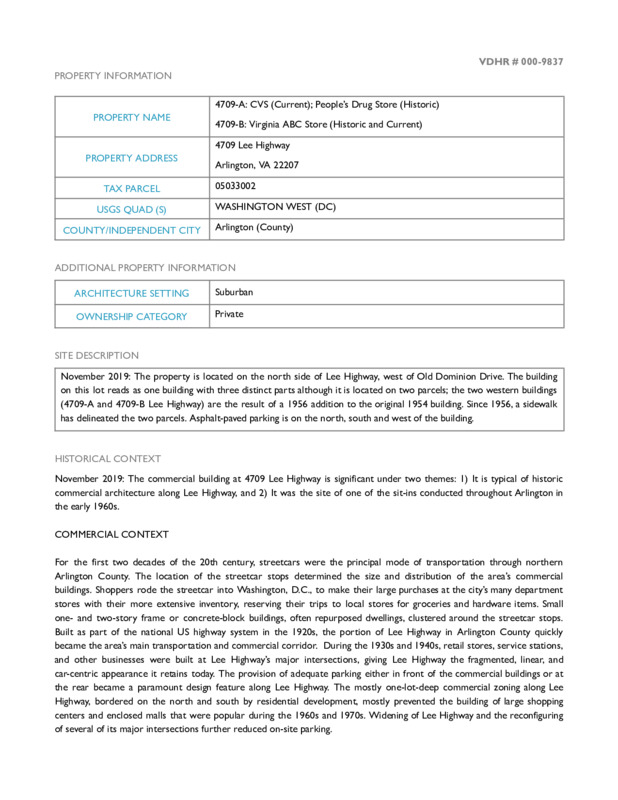
4709-A: CVS (Current); People’s Drug Store (Historic)
4709-B: Virginia ABC Store (Historic and Current)
-
Story
-
The commercial building at 4709 Lee Highway is significant under two themes: 1) It is typical of historic commercial architecture along Lee Highway, and 2) It was the site of one of the sit-ins conducted throughout Arlington in the early 1960s.
CIVIL RIGHTS CONTEXT
On June 22 (1960), five major chains in Arlington agreed to desegregate their lunch counters for the first time. The desegregation had a cascading effect as nearly all department and chain stores in Arlington, Fairfax, and Alexandria, integrated their lunch counter within a few days (ACHPP 2016: 57).
This culminating moment in Arlington County was reached through the bravery and tenacity of the Nonviolent Action Group (NAG), a group started at Howard University, and their supporters. Students from North Carolina Agricultural and Technical College led the first nonviolent desegregation sit-in at Woolworth’s in Greensboro, North Carolina on February 1, 1960. Their passive resistance emboldened others and sit-ins, versus picketing, became a powerful nonviolent method to protest segregation (Jones 2018: 118). In March 1960, Laurence Henry, a Howard University Divinity student, founded NAG when the results of a picket on Capitol Hill with fellow students proved ineffective (Hardin 2015; Jones 2014; ACHPP 2016:57). Henry’s first sit-in locale was Alexandria, Virginia. However, the city proactively decided to have black leaders and whites-only businesses participate in a desegregation study to avoid a sit-in demonstration. It is unclear if Arlington County officials were unwilling to undertake a similar study. NAG’s first official sit-ins occurred along Arlington’s Lee Highway corridor during June 1960. Commercial establishments like Drug Fair, People’s Drug Store and Woolworth were selected for NAG sit-ins because of their hypocrisy. Chains of these stores in Washington, D.C. were desegregated by 1960 but locations in Virginia and Maryland continued to operate by the de facto segregation that persisted in the south (Jones 2014).
NAG led the first sit-in with an interracial group on June 9, 1960 at the People’s Drug Store (4709-A Lee Highway) and the Drug Fair (3811-3815 Lee Highway). Dion Diamond, a fellow Howard University student, and Joan Trumpauer Mulholland, a student originally from Arlington, were two supporters who would put their academics on hold that summer to participate in other civil rights demonstrations in the South. Diamond began private sit-ins at the age of 15 when he “got tired of looking at signs that said whites only” (Diamond 2018). He became a familiar face of the NAG sit-ins in Arlington and other nonviolent demonstrations to desegregate Glen Echo Park, MD. Diamond continued his work in the south becoming a member of the Freedom Riders and the Student Non-Violent Coordinating Committee, which landed him in jail on several occasions. (Washington Area Spark 2013). Joan Mulholland had a similar history. She was a student at Duke University who was presumably home for summer break to participate in many of the Arlington County sit-ins. She became an icon of the Civil Rights Movements as a white southern woman who defied racial stereotypes by actively supporting racial equality and freedom. Mulholland never returned to Duke but would become a graduate of Tougaloo College in Mississippi, a historically-black academic institution. She was a Freedom Rider who participated in over 50 sit-ins and demonstrations by the age of twenty-three and persevered through being disowned by her family, attacked, shot at, put on death row and hunted by the Klu Klux Klan (JTMF n.d.).
Management at both the Drug Fair and People’s Drug Stores closed in response to the sit-ins. The NAG groups returned to the same locations the following day to more success and no arrests. However, when Henry and Diamond attempted to sit-in at the restaurant in Howard Johnson’s (4700 Lee Highway), management had them arrested for trespassing (see Figures 8-9); both were expediently released on $250 bond.
Sit-in participants were trained to withstand crowd retaliation and practice true nonviolence; Calloway United Methodist Church was one HHHVP institution that opened their doors for training. NAG members may not have been physically harmed but they were nonetheless subject to intensely humiliating and antagonistic crowds. One of the most notable crowd retaliation events occurred at the Cherrydale Drug Fair on June 10, 1960, when Diamond was confronted by George Lincoln Rockwell, leader of the American Nazi Party; from 1968-1984, the Arlington office of the American Nazi Party was located at 2507 N. Franklin Road. The group took a brief hiatus to let their actions have their intended effect, which would occur by the end of the month. Sit-ins resumed on June 18, 1960, at the Woolworth’s lunch counter and Lansburgh’s Department Store in Shirlington, VA, located in south Arlington (ACHPP 2016: 57). In an interview for the Columbia Pike Documentary Project, Joan Mulholland, a native Arlingtonian who resides in the Barcroft Neighborhood and grew up in the Buckingham neighborhood, stated the following regarding the relatively quick desegregation of Arlington’s establishments:
These local chains, independent stores, were basically owned by Jewish families. Liberal New York families who had come down for New Deal jobs, and they didn’t have any problem personally with serving people, but it was against the state law. If they did serve us, or you went to a church you were allowed in, anybody who enabled you to sit together anywhere, was subject to arrest, also. So I think the stores’ managers had no problem serving us personally, but they weren’t ready to go to jail today. That’s my interpretation. I’ve heard people who might question that. They aren’t from here. (CPDP 2018)
By the end of the month nearly all department and chain stores in Arlington, Fairfax, and Alexandria desegregated.
-
Place
-
4709 Lee Highway
Arlington, VA 22207